
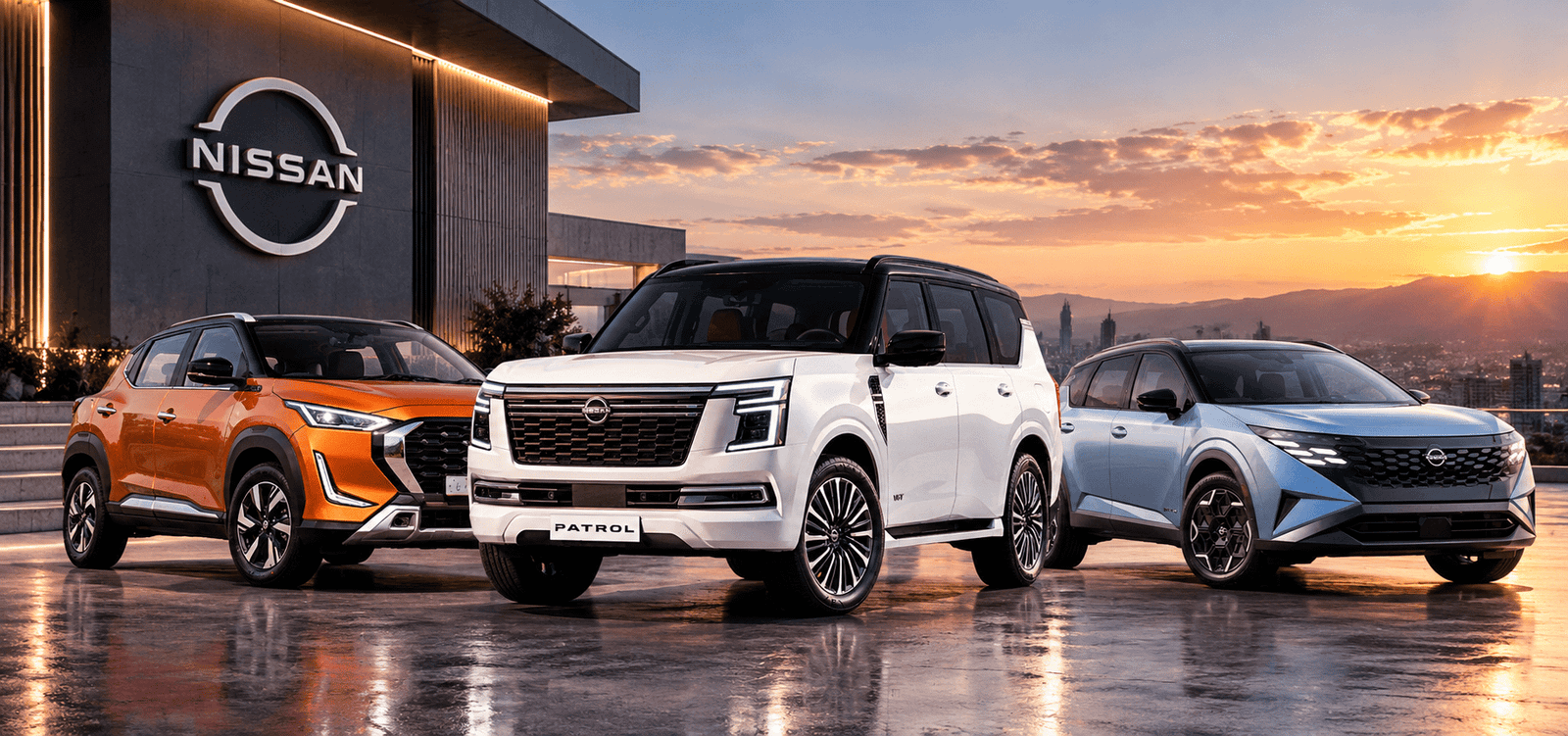
Key Highlights:
- Nissan plans to reduce its global portfolio from 56 models to 45
- The company will focus on three major product families and offer more powertrain options
- The US, Japan, and China remain Nissan’s key markets
Nissan is planning a major restructuring of its global operations, with the Japanese automaker confirming that it will discontinue 11 models from its existing line-up. The move is part of the company’s strategy to improve profitability by focusing on stronger-performing products and investing in areas with better growth potential.
The plan, outlined alongside the global unveiling of the new Juke EV and next-generation X-Trail, will reduce Nissan’s model portfolio from 56 vehicles to 45 in the coming period. The company also plans to expand powertrain choices across its range to better meet the needs of customers in different markets.
Why Is Nissan Discontinuing 11 Models?
Nissan’s main objective is to return to profitability by simplifying its product line-up and directing investment towards models with stronger demand. CEO Ivan Espinosa said the company intends to phase out underperforming products and reinvest in opportunities that offer better growth prospects.
Alongside reducing the number of models, Nissan plans to concentrate development on three major product families. According to Espinosa, these families are expected to account for more than 80 percent of the company’s total volume. The strategy is intended to help Nissan use its development resources more efficiently while responding to changing market requirements.
The automaker will also offer customers a wider choice of powertrains, allowing its models to cater to different preferences and regional requirements.
Which Models Will Shape Nissan’s Future?
Nissan plans to organise its future global portfolio into four categories: Heartbeat, Core, Growth, and Partner. Each category will serve a different purpose in the company’s long-term product strategy.
The Heartbeat category will include key models such as the Leaf EV and Patrol SUV. The Core category will feature important volume drivers, including the X-Trail and Qashqai. Meanwhile, the Growth category will include vehicles such as the Elgrand MPV and Sakura Kei car.
The Partner category will comprise models such as the Micra hatchback and Frontier Pro pick-up truck.
Nissan is also counting on upcoming models, including the next-generation Skyline, X-Terra, X-Trail (Rogue) Hybrid, and Juke EV, to strengthen its position in their respective markets.
Its premium sub-brand, Infiniti, will continue to play a role in the company’s future plans. CEO Ivan Espinosa said Nissan intends to develop and expand the brand. Beyond the QX65, Infiniti is expected to introduce four new models with different powertrain options. These will include a midsize hybrid SUV, a performance-focused V6 sedan, and two large hybrid SUVs built on a frame-based platform.
Japan, the US, and China Remain Nissan’s Key Markets
Nissan has identified Japan, the United States, and China as its three lead markets. According to Guillaume Cartier, the company’s chief performance officer, these regions are important for achieving sales volumes and profitability while providing technologies, products, and manufacturing capabilities that can also be used in other markets.
By fiscal year 2030, Nissan aims to achieve annual sales of 5.50 lakh units in Japan, 10 lakh units in the United States, and 10 lakh units in China.
Beyond these three markets, Nissan will continue to focus on Mexico and the Middle East, followed by Europe, Africa, and India. These regions will remain important to the company’s broader global operations.
What Does This Mean for Nissan India?
Nissan currently has two models on sale in India: the Magnite SUV and the Gravite MPV. While India is not among the company’s three lead markets, it remains part of Nissan’s wider international strategy.
The global restructuring is aimed at simplifying operations, improving profitability, and concentrating resources on products with stronger potential. As Nissan moves towards its 2030 goals, its future performance will depend on how effectively it balances its core markets with opportunities in other regions, including India.