
A few years ago, an electric car in India was a brave choice. In 2026, it is a sensible one. In September 2026 alone, Indians bought over 36,000 electric cars, almost double the number from a year earlier. Nearly one in every twelve new cars sold is now electric.
But a growing market also means more confusion. Which EV fits your budget? How much range will you really get? Is there still a subsidy? And does an electric car actually save money?
At Basttl Auto India, we have put together this complete, up to date guide so you can decide with facts, not hype.
India’s EV market in 2026: the numbers that matter
According to FADA (Federation of Automobile Dealers Associations), September 2026 was a record month for electric vehicles in India:
- 3,33,634 EVs were sold across all segments, up 74% year on year
- 36,108 electric cars were sold, up nearly 95%
- EV share of all new cars rose to 8.5%, from 5.7% a year earlier
- Electric two wheelers crossed 2 lakh units in a single month for the first time
Tata Motors still leads electric car sales with over 40% market share, followed by Mahindra and MG. Newer players like VinFast are growing quickly, while Maruti Suzuki, Hyundai, Kia and Toyota are adding more electric models every few months.
What this means for you: more choice, better prices, a stronger resale market and a fast growing service network.
Electric car price list in India (October 2026)
Here are the popular electric cars on sale right now, with their starting and top ex showroom prices.
| Electric car | Ex showroom price range |
|---|---|
| MG Comet EV | Rs 6.41 lakh to Rs 8.72 lakh |
| Tata Tiago EV | Rs 6.99 lakh to Rs 10.09 lakh |
| Tata Punch EV | Rs 9.79 lakh to Rs 12.99 lakh |
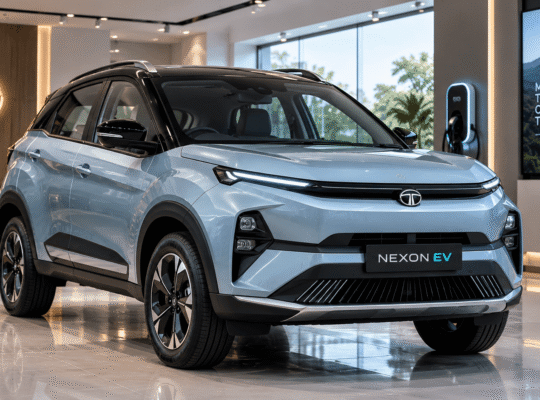
| Tata Nexon EV | Rs 11.63 lakh to Rs 17.89 lakh |
| MG Windsor EV | Rs 12.36 lakh to Rs 18.00 lakh |
| Maruti Suzuki e Vitara | Rs 13.61 lakh to Rs 17.46 lakh |
| Mahindra XUV 3XO EV | Rs 13.89 lakh to Rs 15.46 lakh |
| Tata Curvv EV | Rs 14.06 lakh to Rs 19.69 lakh |
| Hyundai Creta Electric | Rs 14.53 lakh to Rs 25.22 lakh |
| Tata Sierra EV | Rs 15.33 lakh to Rs 26.48 lakh |
| Mahindra BE 6 | Rs 15.45 lakh to Rs 27.70 lakh |
| Mahindra XEV 9e | Rs 17.85 lakh to Rs 31.25 lakh |
| Kia Carens Clavis EV | Rs 18.04 lakh to Rs 25.00 lakh |
| Tata Harrier EV | Rs 18.10 lakh to Rs 30.54 lakh |
| VinFast VF 6 | Rs 18.19 lakh to Rs 20.09 lakh |
| BYD Atto 3 | Rs 24.99 lakh to Rs 34.49 lakh |
| Tesla Model Y | Rs 50.90 lakh to Rs 61.99 lakh |
| Volvo EX90 | Rs 1.26 crore |
Prices change often and some brands run introductory offers, so always confirm the latest price with your dealer.
What is battery as a service (BaaS)?
Some brands now let you buy the car without the battery and pay for the battery separately, per kilometre. For example, the Tata Tiago EV starts at Rs 4.69 lakh under BaaS, plus a battery usage charge of Rs 2.6 per km. The MG Comet EV, Tata Punch EV, Citroen eC3 and Kia Syros EV also offer battery rental plans.
BaaS lowers the upfront price, but the per km charge adds to your running cost. It suits buyers who want a low entry price and drive less. If you drive a lot, outright ownership usually works out cheaper over time.
Claimed range vs real world range
Every EV maker quotes a claimed range, tested in ideal lab conditions. On Indian roads, with AC, traffic, highway speeds and summer heat, real world range is usually 15% to 25% lower.
Simple rule: take the claimed figure and reduce it by about one fifth. A car with a claimed 500 km should comfortably give you around 380 to 420 km in daily use.
Also keep in mind:
- Highway driving at high speed uses more energy than city driving
- EVs are most efficient in stop and go city traffic, thanks to regenerative braking
- Winter can reduce range because the battery chemistry slows down and the heater uses battery power
EV running cost vs petrol: the real maths
This is where electric cars really shine. Here is an illustrative comparison using typical figures:
| Electric car (home charging) | Electric car (public fast charging) | Petrol car | |
|---|---|---|---|
| Energy price | About Rs 8 per unit | About Rs 20 per unit | About Rs 100 per litre |
| Efficiency | About 7 km per unit | About 7 km per unit | About 15 km per litre |
| Cost per km | About Rs 1.1 | About Rs 3 | About Rs 6.7 |
If you drive 15,000 km a year and charge mostly at home, you could spend roughly Rs 17,000 a year on charging compared with about Rs 1 lakh on petrol. That is a saving of around Rs 80,000 every year.
Your actual savings depend on your electricity tariff, charging habits and driving style, so use these figures as a guide.
EVs also have fewer moving parts: no engine oil, no clutch, no spark plugs. Routine service costs are usually lower too.
EV charging in India: how good is the network?
According to the Ministry of Heavy Industries, India had 52,718 public EV charging stations as of July 2026, including 16,561 stations with fast chargers for cars. The government has allotted Rs 2,000 crore under the PM E-DRIVE scheme to build more public chargers, especially in cities and along highways.
Our honest advice:
- Home charging is the backbone. Most EV owners charge at home or at work overnight. If you cannot install a charger where you park, think carefully before buying.
- Use public fast chargers for road trips, not daily use. They cost more and frequent fast charging is not ideal for long term battery health.
- Plan highway trips with an app and keep a backup charger in mind, since reliability still varies by location.
Battery warranty: the biggest fear, answered
The battery is the most expensive part of an EV, so the warranty matters a lot. Most manufacturers in India offer battery cover of around 8 years or 1,60,000 km, and many now go much further.
- Tata Motors offers a 15 year, unlimited km battery warranty for the first owner on selected models, including the 24 kWh Tiago EV, Curvv EV and Nexon EV 45 kWh
- Kia has introduced a 15 year battery warranty on the Carens Clavis EV
Read the fine print. Most warranties cover manufacturing defects and abnormal capacity loss, with brands typically promising that the battery keeps 70% to 80% of its original capacity during the warranty period. Normal ageing, accident damage and improper charging are generally not covered. Always use the charger and charging practices your manufacturer recommends.
EV subsidy and tax benefits in India 2026
Here is what you can and cannot claim today:
- GST: Electric cars attract only 5% GST, while petrol and diesel cars attract 18% or 40% depending on size and engine. This benefit is already built into the price you pay.
- Central subsidy: There is no direct central cash subsidy for electric cars. The PM E-DRIVE scheme supports electric two wheelers (Rs 2,500 per kWh, capped at Rs 5,000, now extended till March 2028), three wheelers, buses, trucks and charging infrastructure.
- State benefits: Several states offer road tax or registration fee waivers on EVs, which can save you a significant amount on the on road price. Policies change often, so check with your state transport department or dealer before you buy.
New EV rules you should know
- Sound alert for EVs: From 1 October 2026, all new electric car and goods vehicle models must have an Acoustic Vehicle Alerting System (AVAS), which makes a sound at low speeds so pedestrians know the car is coming. Existing models must comply by 1 October 2027.
- No PUC needed: Electric cars have no tailpipe emissions, so they do not need a Pollution Under Control certificate.
Should you buy an EV or a hybrid?
Choose an EV if:
- You can charge at home or at work
- Most of your driving is within the city
- You drive more than 30 to 40 km a day, so the savings add up quickly
Choose a hybrid or petrol car if:
- You cannot install a home charger
- You frequently drive long distances on routes with few chargers
- You want the lowest possible upfront price in a bigger SUV
Our 7 point EV buying checklist
- Confirm home charging before you book. Check whether your society or building allows a charger.
- Calculate real range by reducing the claimed figure by about 20%.
- Compare total cost, not just ex showroom price. Include insurance, road tax waivers, charger installation and running cost.
- Read the battery warranty terms, especially for the first owner and second owner.
- Check the service network in your city, especially for newer brands.
- Test drive in real traffic, and try regenerative braking modes and one pedal driving.
- Ask about the home charger: is it included, and who pays for installation?
Frequently asked questions
Which is the cheapest electric car in India in 2026?
The MG Comet EV and Tata Tiago EV are among the most affordable, with prices starting under Rs 7 lakh. With battery as a service, the Tiago EV starts at Rs 4.69 lakh plus a per km battery charge.
How long does an EV battery last in India?
With normal use and good charging habits, an EV battery can retain 70% to 80% of its capacity even after eight years. Several brands now offer battery warranties of up to 15 years.
Is there a government subsidy on electric cars in India?
There is no direct central subsidy for electric cars in 2026. However, EVs benefit from just 5% GST, and many states offer road tax or registration waivers.
How much does it cost to charge an electric car at home?
At around Rs 8 per unit, a typical EV costs roughly Rs 1 to Rs 1.5 per km to run on home charging, compared with around Rs 6 to Rs 7 per km for a petrol car.
Do electric cars need a PUC certificate?
No. Electric cars have zero tailpipe emissions, so they are exempt from PUC.
The Basttl Auto India verdict
Electric cars in India have moved from experiment to everyday choice. Prices are falling, battery warranties are longer than ever, and running costs are a fraction of petrol. The one thing that decides everything is charging access. Sort that out, and an EV can be the smartest car purchase you make this decade.
Confused about which EV suits your budget and daily use? Drop your questions in the comments or reach out to the Basttl Auto India team for a free car buying consultation. We will help you pick the right car, not just the most popular one.
Sources: FADA retail data for September 2026; Vahan registration data; Ministry of Heavy Industries Lok Sabha reply, 21 July 2026; Ministry of Heavy Industries PM E-DRIVE notification; CarWale and Autocar India price listings, October 2026; manufacturer announcements. Prices and policies were checked on 26 October 2026 and may change.