
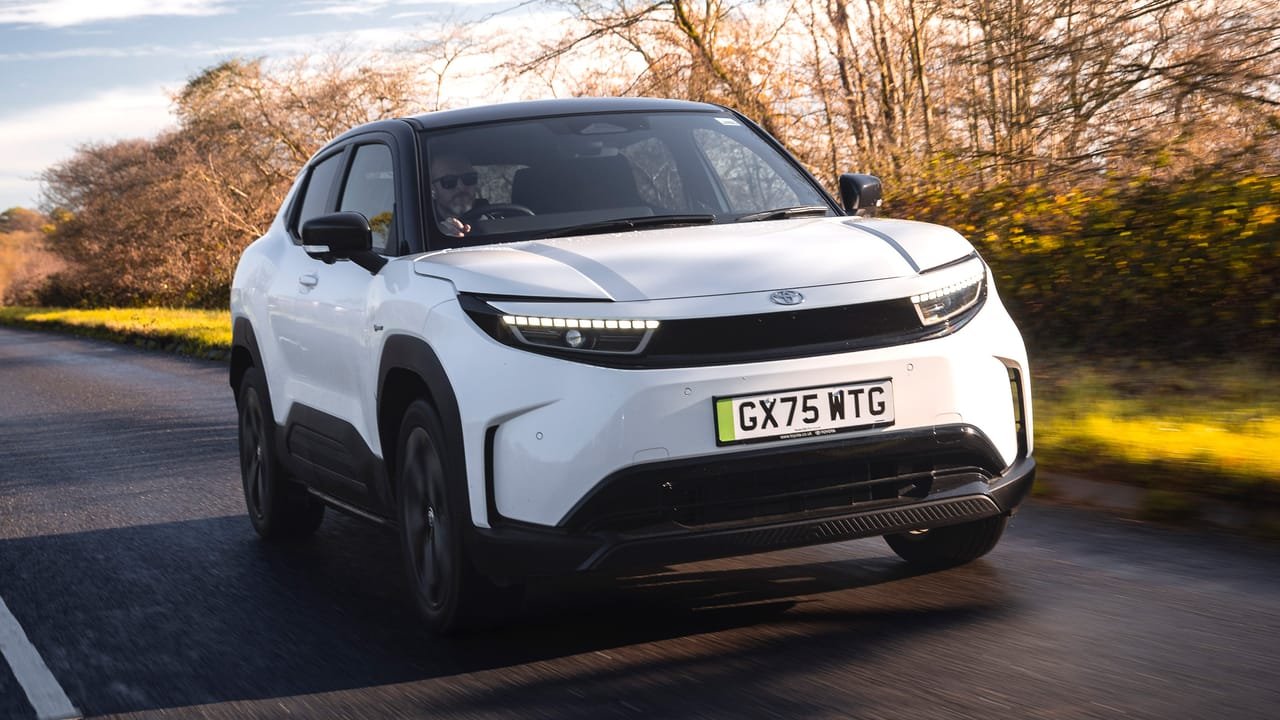
Toyota’s second ever electric car. For which there’s been a jolly long wait – the Japanese manufacturer’s first effort was the larger bZ4X back in 2022, and after that… nada.
That’s because Toyota has been coy about the switchover to EVs, preferring to keep its powder dry rather than join the rush to stick a battery in just about everything it makes. Still, it has plans for half a dozen electric models in Europe, including the C-HR+ that popped up in the second half of 2025 and later this year… [pause for effect] an electric Hilux. Now we’re talking.
Advertisement – Page continues below
Anyway, the Urban Cruiser: it’s a small-ish crossover that’s essentially a rebadged version of the Suzuki eVitara. Their common platform is called Heartect-e (catchy, eh?) and they run exactly the same motors, and batteries, and interior design, and touchscreen setup. Mechanically speaking, they are one and the same car.
They look different though.
From the front, sure – the Urban Cruiser gets what Toyota calls its ‘hammerhead’ front end design, tying it into the same genetic makeup as the rest of the Toyota family. However the flanks and the rear are more or less identical. We’ll let you decide whether or not it’s an improvement on the chunkier Suzuki.
Platform sharing is nothing new, but it puts us in mind of that Open All Hours episode where Granville begs for a van to replace his tatty old bike and Arkwright, being the ultimate penny pincher, contrives to spend as little as humanly possible. And yes, more modern metaphors are available.
Anyhow, this is the strategy and with so much doubt hanging over the ICE ban here and abroad, you can see why Toyota is hedging its bets.
Advertisement – Page continues below
Enough background. Tell me about the car.
The Urban Cruiser comes in two flavours. The first has a 144bhp motor and a 49kWh battery for 214 miles of range WLTP, and the second packs a 174bhp motor and 61kWh battery for 265 miles. Both are front-wheel drive: an even more powerful, all-wheel drive version is on the cards but it’s yet to materialise in the UK. Suzuki’s AWD one is here already.
Naturally the latter setup is quicker, 0-62mph taking 8.7 seconds versus 9.6s.
DC charging is… also not very fast. The two powertrains are capped at 53 and 67kW respectively, meaning both can be rejuiced from 10 to 80 per cent full in 45 minutes. A long-distance holiday wagon this is not. On single-phase AC (aka at home) you’re limited to 7kW; enough for overnight top-ups.
And is it any good to drive?
It’s not in the slightest bit taxing, we’ll say that. The throttle and brakes respond faithfully and it’ll even sit on the motorway quite happily without demanding much from you. The steering is fluid and the car excels in tight turns – it’s called the ‘Urban’ Cruiser for a reason.
There are flaws though: even up to 30mph it’s sluggish in what should be its natural environment, the ride is unforgiving on 19in wheels (again, in a town car?) and despite some sound insulation measures refinement is harsh.
It’s also laughably inefficient. Click on the Driving tab of this review for the full nuts and bolts of it.
Does the interior make up for it?
Erm, no. Whether its design and materials, there’s precious little about the Urban Cruiser that makes you want to own one. The gloss plastic on the centre console is particularly nasty and the location of the drive selector means you’re in danger of dumping the car into neutral – as we did on our test drive – while reaching for a drink in the cupholder. Whoops.
And while the touchscreen is better for functionality than the brand’s more common Toyota Sense 3 system (which we abhor), it is woefully slow. Like, knock-off-telly-on-its-last-legs slow.
Again, you’ll find a fuller breakdown in the Interior section of this review.
Right, right, but at the very least it’s cheap…
Wah wah waaaahhh. Wrong again. The Urban Cruiser doesn’t qualify for the Electric Car Grant, so Toyota has had to dip into its own pocket to produce a £1,500 discount that brings the starting price down to £28,495.
Upgrading to the bigger battery will set you back another four-and-a-half grand, putting it firmly in the ballpark of the more talented Kia EV3, more stylish Volvo EX30, and more rewarding Renault Megane E-Tech Electric. Uh oh.
At least you get a heat pump, 10.1in touchscreen, 360-degree camera and adaptive cruise control as standard. Scant consolation though.
What’s the verdict?
“The Urban Cruiser can’t even play Toyota’s strongest USP; the outstanding efficiency that sets its petrol-hybrids apart”
The Toyota Urban Cruiser is an easygoing, straightforward electric crossover that makes everyday driving a doddle. So if you’re saying goodbye to internal combustion but find the idea of going full electric a daunting one, this is about as scary as a U-rated rom com.
And that’s about as much praise as we can level at it. Virtually every performance parameter is sub par: the handling is limited, the ride is uncomfortable, the cabin is drab and neither the boot nor the back seats are that spacious, even allowing for the adjustable rear bench. Oh, and the touchscreen isn’t fit for purpose.
Worse than that though, is that the Urban Cruiser can’t even play Toyota’s strongest USP; the outstanding efficiency that sets petrol-hybrid stuff like the Yaris, Corolla and Prius apart. In winter you’re looking at real-world range of 160 miles with the bigger battery. Not good.
This is exactly what you get when you lean on someone else to do the legwork and don’t invest the time or effort yourself. Not Toyota’s finest hour.