
► We drive Skoda’s first small family EV – the Epiq
► It’s just a prototype for now, but it looks promising…
► … and it’s fixed our biggest electric car bugbears
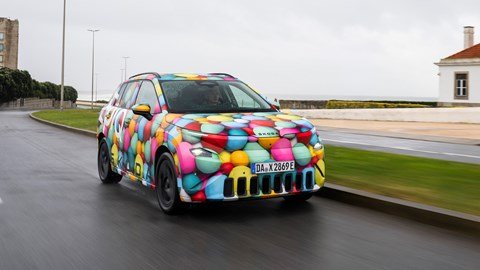
Small electric family cars are quite difficult to build, which is probably why it’s taken so long for the new Skoda Epiqto break cover. However, Skoda was so keen to show its homework that it invited me out to Portugal to have a go in an unfinished prototype before the completed car hits showrooms in the autumn of this year.
The Skoda Epiq has quite the challenge ahead, as the list of market expectations for a B-segment EV is huge. Cars in this class need to package a 200-mile driving range, more than 400 litres of boot space and enough passenger room for four adults into a four-metre-long, SUV-shaped box. It also can’t cost much more than £20,000, which is tricky when you’re trying to recoup the costs of launching a fresh car on a brand-new platform.
Because it’s such a difficult task, Skoda has taken its sweet time working out the details – and that means it’s been beaten to the punch by rivals such as the BYD Atto 2, Kia EV2 and Renault 4 E-Tech. Last movers’ advantage might work in Skoda’s favour, though, as my early impressions of this prototype suggest the brand has used that extra time to solve some of the most irritating aspects of electric car ownership.
Keep reading to find out what you’ve got to look forward to.
At a glance
Pros: great to drive, excellent brake feel, hugely practical, promising ride quality
Cons: it’s a prototype, so we’re still unsure about driving range, efficiency and reliability
What’s new?
Basically everything. The Skoda Epiq is based on the Volkswagen Group’s new MEB+ platform, which is also found beneath the ID.Polo and Cupra Raval hatchbacks. It’s a simpler, front-wheel drive architecture, designed to underpin a new wave of A- and B-segment EVs that’ll hopefully do a better job of competing with the incoming Chinese brands on price.
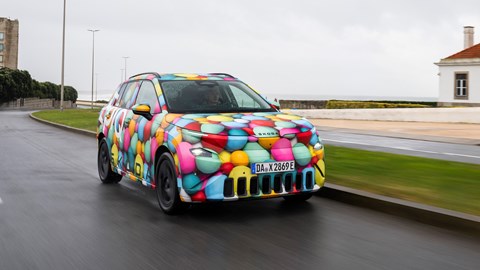
The Epiq is also the first Skoda to adopt the firm’s new ‘Modern Solid’ design language. You can’t really spot the difference thanks to the camouflage, but I’ve seen an uncamouflaged version of the car in the studio – and it looks far more rugged and retro than Skoda’s current product range. The brand hopes this shift will serve the current appetite for old school design, as deployed to great success by the Renault 4 and 5 EVs.
What are the specs?
The finished Skoda Epiq will be available in three technical specifications, called 30, 40 and 55. The entry-level and mid-range variants will have 37kWh batteries and a maximum driving ranges of 196 miles, while the flagship 55 model gets a larger 51.7kWh battery and a longer range of up to 272 miles.
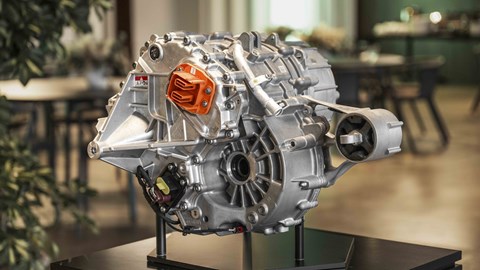
Each specification has its own motor although, unlike the larger Elroq, all are mounted on the front axle rather than the rear to liberate some extra boot space. The 30 has 114bhp, the 40 gets 133bhp and the 55 produces 209bhp. 0–62mph times range between 11.0 and 7.4 seconds, which is plenty fast enough for a town-sized SUV.
Charge times vary slightly depending on the model you opt for, but the flagship Epiq can charge from 10 to 80% capacity in 22 minutes when connected to a 125kW DC rapid charger. For context, the Fiat Grande Panda charges from 20 to 80% capacity in 27 minutes using a 100kW DC feed, so the Epiq should be more convenient to drive long distances.
How does it drive?
Very well. My colleagues primed me on the merits of MEB+ before I left. They’d recently returned from prototype drives of the Volkswagen ID.Polo and Cupra Raval and they were gushing about the how well both cars drove – so my hopes were quite high for the Epiq.
Unfortunately, I only had a half-hour stint at the wheel before Skoda’s engineers hurried the prototypes back into storage. But that was just enough time to learn that the Volkswagen Group has changed the small electric car game with its MEB+ platform, because the Epiq is an electric car that feels like a normal car to drive.
The biggest improvement for the platform is the brake pedal feel. Volkswagen has designed a new type of pseudo fly-by-wire brake servo with what’s basically a rubber block between the pedal and the hydraulics. The rubber works like a damper for your foot, while the computers manage the changeover from regenerative to friction braking. And it works well. The Epiq’s pedal is far more predictable and linear than the brakes on the old Enyaq.
The steering is a bit sharp off centre, which I quite like. It makes the Epiq feel nimble and light – although I would have liked the opportunity to test the car on the motorway to make sure the system doesn’t feel nervous and twitchy at high speeds. Sadly, my guided test route was mainly on city streets. I barely managed to get above 50km/h.
The benefit of that is I got plenty of time to test the Epiq’s low-speed ride quality which, I’m pleased to report, is good. The damping is firm without being punishing, which I don’t mind as I value being able to sense changes in the road surface through the chassis.
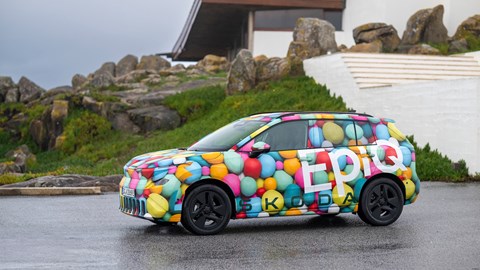
I appreciate that some family buyers will prefer the floatier ride of the Citroen e-C3, but I suspect the Epiq’s tauter suspension will make it more composed on a challenging road – and therefore less likely to induce motion sickness in small children. I’ll have to wait until I drive it in the UK to find out.
I also like how Skoda has fitted the Epiq with sensibly sized wheels. My car rode on 18-inch alloys, which meant there was enough flex in the sidewall to absorb the initial impact of a bump before passing the rest of the forces into the suspension.
Skoda still has some tuning left to do, though. The accelerator pedal on my car was very doughy at the top of its travel, which I found a bit unnerving at junctions as the Epiq didn’t have the urgency I’ve grown to expect from an EV. I really needed to mash the pedal to make it move in its standard drive mode.
The chassis isn’t quite perfect yet, either. A key goal for MEB+ was to move as much of the drivetrain and its associated controllers to the front of the car, as that creates more space at the back for passengers and luggage. The trade-off for this is that it makes the car quite nose-heavy – and I could sense that, even at slow speeds.
On a couple of occasions, I felt the rear end go light over speed bumps and crests. That’s not a huge problem at town speeds, but it could be unsettling when you’re belting down a bumpy British B-road at 60mph – especially if there’s nobody in the back to weigh it down. I’m sure it can be dialled out with a bit more ride height and damper fettling.
I also shouldn’t complain too much about this, because it shows Skoda has taken one of our biggest complaints about electric cars seriously. We’ve been saying for years that EVs are too heavy, but the finished Epiq is expected to weigh just 1,500kg. That’s nothing as far as electric cars are concerned.
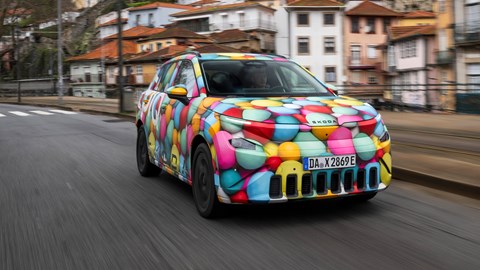
For context, the Smart #1 weighs around 1.8 tonnes while the lightest Peugeot e-3008 weighs a whopping 2.1 tonnes – and the 300–600kg weight saving the Epiq offers over these competitors should bring some serious efficiency benefits, as its motors and batteries won’t need to work as hard to haul the car around.
What about the interior?
Unfortunately, I’m not allowed to show you the cabin until the finished car is unveiled in May. Just imagine someone shoved the Elroq’s interior through a photocopier at 90% scale and you’re about there. It’s remarkably familiar, sharing the same infotainment layout, the same steering wheel and the same row of shortcut buttons in the middle of the dash.
I can’t really comment on build quality, as the car I drove was trimmed in non-production spec materials and littered with blanking plates to hide its newest design elements (such as its wraparound ambient lighting strips) until the official launch. The ergonomics won’t change between now and autumn, though – and they’re brilliant.
The wheel telescopes a long way out of the dashboard, which means you don’t need to scrunch your legs under the dashboard to get comfortable like you do in the Fiat 600e. You can almost drop the seat to the floor, too, which is great if you’re tall. If I had to nitpick, the Epiq’s A-pillars do impede visibility. They’re very wide and they flare out where they meet the car’s waistline, which means you can lose cars in them at junctions.
Getting back onto the positives, the Epiq is very well packaged. Rear seat space is slightly more generous than a Renault 4 E-Tech as, even with the front seat in my driving position, I had a couple of inches of space between the seat back and my knees. There’s also more space under the front seats for your feet than the Renault 4, although headroom isn’t quite as generous.
Skoda compensates for that with the Epiq’s – erm – epic boot. You get 475 litres with the rear seats in place, thanks to an enormous Ford-Puma-style storage box under the boot board. It can’t compete with the Puma Gen-E’s 574-litre effort for outright capacity, but it’s still eons ahead of the 361 litres offered by the Fiat Grande Panda Electric.
Plus, more expensive versions of the car will get an 18-litre storage bin under the bonnet for your charging cables. I’m disappointed Skoda couldn’t offer that as standard across the line-up but, when you’re dealing with margins this neat, every penny counts.
Verdict
I can’t yet call a definitive verdict on the Epiq, as the cars Skoda offered to the media were quite obviously working prototypes. There were parts of my car that simply didn’t work, while the car driven by my colleagues had an intermittent electrical fault that cut drive to the motor.
Despite these teething issues, I suspect the Epiq will grow into the best electric car Skoda has built to date – especially if the brand meets its goal of achieving price parity with the Kamiq. £25,000 is good value for the range and practicality the Epiq offers.
That’s before you factor in the Epiq’s driving experience, too. It probably isn’t as exciting as the Ford Puma Gen-E, but it’s eons ahead of any MEB-based electric car I’ve tried. It might even be better than the Renault 4, which is high praise indeed.
What’s more, the Volkswagen Group’s magical new brake servo has solved one of our biggest electric car pain points – unpredictable brake feel. You don’t need to adapt your driving technique to get the best from the Epiq, which removes one more hurdle for drivers making the switch to an electric car. That’s important when you consider Skoda’s target customers will likely be stepping out of an older combustion car like the Karoq or Kamiq.
I’m interested to learn how efficient the Group’s new MEB+ motors and batteries are in the real world, as I couldn’t draw any meaningful figures from my limited drive of this prototype. My hopes are high, though. The Epiq might just live up to its namesake. Roll on the autumn.